

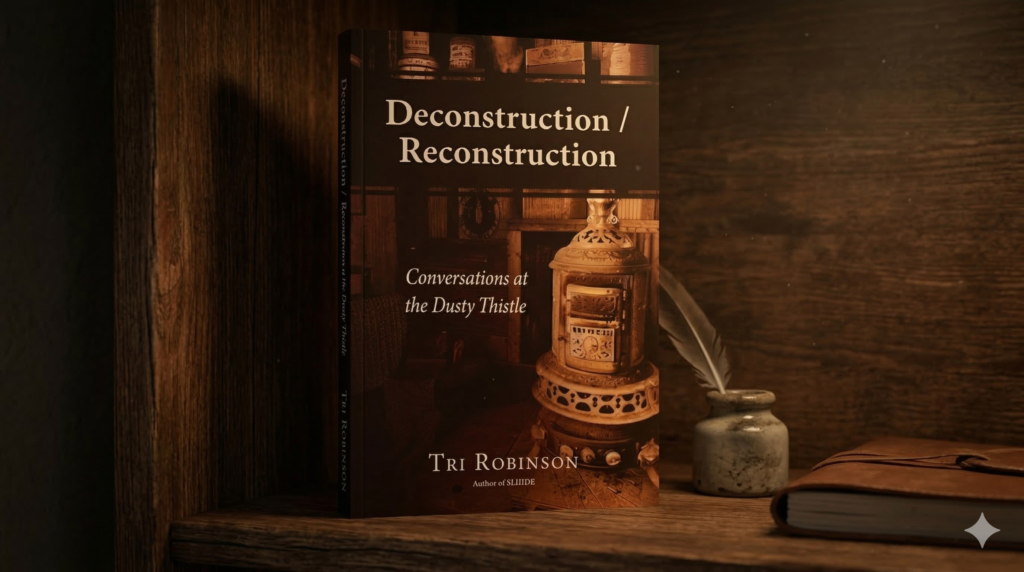
As Tri Robinson writes in Deconstruction/Reconstruction (2025), the generations of today are struggling with faith because, in this post-everything world (especially post-trust), they experience a reality in which they equate the institutional church with Jesus. When the church lets them down, they feel Jesus has let them down, too. This is often at the heart of “Deconstruction.” Robinson, a veteran of the Jesus Revolution, once a pastor of a large church, turned grandfather and Idaho Rancher, argues that this generation authentically needs a “revelation of [God’s] reality in their hearts before it makes sense in their minds.” That is what worked for his generation, and undoubtedly it is what needs to happen for the next generations.
The “Secondhand Smoke” of Cultural Stress
Robinson suggests that younger generations are suffering from “secondhand smoke” of the generation(s) before them. What an image, and certainly one that resonated and remained with me. Though the previous generation(s) witnessed some significant and radical cultural and ecclesiastical changes firsthand, their children are the ones inhaling the resulting stress, anxiety, and leftover problems. In a world where confusion is already present, where AI makes reality seem hard to discern, where distrust is more trusting than truth, this secondhand smoke of the previous world has become a breaking point for many. This “post-everything” generation is deeply anxious, grappling with climate change, violence, and a digital landscape filled with “unvetted biased commentary.”
As a father and a doctoral student researching the Lord’s Prayer, I see this post-everything reality everywhere. I name it in the center of my work. Many other cultural observers also describe the present moment as a “post-everything” generation. Craig Springer has remarked that we live in a world that is increasingly post-Christian, post-family, post-technology, and post-supersize. With that, I add that in the confusion and chaos of the world, we have also become increasingly post-trust. Shared spiritual practices have eroded, families and communities are fragmented, and many people are searching for meaning while lacking the rhythms that once formed faith. Often, these individuals struggling to find absolutes are not just deconstructing for the sake of rebellion; they are searching for something to trust when legalistic, short answers no longer suffice.
From Spiritual Wonder to Professionalism
Robinson is in a unique position to reflect on how the church emerged, changed, reformed, and also retreated in the days after the Jesus Movement. As a member of that movement who turned to Pastoring in a church network that emerged at that time, he offers some unique ideas on the question, “What happened to the vibrant energy of the Jesus Movement?” Robinson points out that the church—specifically the founding movements like the Calvary Chapel and Vineyard USA—became more “professional” and, consequently, less “Spirit-filled.” Somehow, they grew up and grew old, and lost some of that sense of wonder that once invited God’s presence. That sense of wonder, over time, became a predictable strategy and was replaced by strategy and platformed personalities.
For Robinson, this shift was accelerated by two major factors: the rise of “yuppie” culture, in which money and power pushed the movement’s margins into the establishment. I think it is the power and ability to shape and control, rather than money. Too often, the most radical became the most radicalized. Robinson also points to the emergence of the “Moral Majority.” As someone who watched the Moral Majority emerge in my youth, I think Robinson is on to something significant here. Robinson notes that reliance on the Holy Spirit diminishes when the church turns to political solutions. It’s happened before in history. The pursuit of political domination has caused significant “collateral damage” (as Robinson points out), leading many younger people to reject the church entirely.
A Call for “New Lights” and Spiritual Awakening
In Deconstruction/Reconstruction, Robinson references David McKenna’s stages of spiritual awakening. I was not familiar with this framework, and I appreciated encountering it in the creative way that Robinson unloaded it. It could be said that we are currently in a state of “cultural disjuncture,” which is a disconnection from trusted institutions. According to McKenna, awakenings always start with the emerging generation and prophetic voices that push for greater change and reform, an emerging group with whom he calls “New Lights.”
As we look around, I think we would all agree that we need these “New Lights” to encounter a real Jesus and to have anchoring experiences with the Holy Spirit. This isn’t about arguing philosophy or ethics; it’s about making space for authentic experiences. I refer to this as the quiet way of formation for myself. This is about faithful presence, not power and position. the Lord’s Prayer, the intersections of faith and everyday life, and the quiet, resilient spirituality formed in quiet ways. On my Patheos blog, Lead a Quiet Life, I have focused much of my writing exploring the biblical invitation of 1 Thessalonians 4:11–12 to lead a quiet life—because I think more than ever we need the quiet way: a slower, more grounded approach to Christian faith in a world shaped by noise, hurry, and excess. I think our churches need that too, so people can encounter God as they need to, not in a curated space. As Robinson notes, God has provided many ways for people to discover His love because He created everyone differently.
Conversations at the “Dusty Thistle”
The book itself is written as a creative narrative, similar to a Patrick Lencioni “leadership fable.” Set in a barn-turned-private-tavern called the Dusty Thistle (a real place), Robinson hosts honest conversations with representative characters from Generation Z. While the characters are fictional, the conversations are very real, and are based in ones Robinson has had with many.
I will shoot straight. I am not usually a reader of parables or novels. However, after posting about something similar, Robinson sent me this and asked me to read it. Let me tell you, this book is a quick, reflective read—just over 110 pages. Once I started it, it was hard to put down. It was one of those books you want to read in a sitting. I think this unusual way of writing a book, in itself, offers a prophetic expectation of what might come if we stop trying to force people into righteousness and instead meet them with prayer, listening, and authenticity.
Final Thoughts on The Quiet Way
This book, Deconstruction/Reconstruction, helps reframe how we see the faith journeys of those around us. It challenges those of us in leadership to recognize where we have traded wonder for professionalism. If we want to see a true reconstruction, we might have to be okay with some deconstruction, and we must move past ways and political agendas, returning to a reliance on the Holy Spirit in slow-cooked, quietly formed ways. The book doesn’t end with resolve, but like good jazz, it stays in the mind in a way that keeps your toes tapping in a direction to find that resolve through conversations you have at the intersections of life.
As I continue to explore The Quiet Way in my own ministry and writing, Robinson’s reflections serve as a vital reminder: we cannot argue people into faith, but we can pray for them to have a revelation of Jesus for themselves. In the past I have read Robertson’s book, A Journey of Gratitude, which echoes a life lived well by this quiet way.
Key Takeaways for the Journey
In reflecting on Robinson’s insights through the lens of my own work and The Quiet Way, here are the three primary shifts that I am admitting that I need to affirm and name outloud:
- We must challenge a church that has traded presence for politics. We must heed the warning that a reliance on the Holy Spirit diminishes the moment we pivot toward political solutions for spiritual problems. Reconstruction requires us to trade the desire for cultural domination for a renewed pursuit of God’s presence.
- We must challenge ourselves regarding the secondhand smoke we’ve created. We have to recognize that the anxiety and deconstruction in the younger generation aren’t necessarily a rejection of Jesus, but a reaction to the “cultural smoke” they’ve inhaled. Our role is to provide a pocket of clean air—a space of safety and trust—where they can breathe and seek truth without pressure.
- We must prioritize simplicity that permits personal revelation over professional curation. You cannot argue or strategize someone into a transformed heart. Just as Tri emphasizes, this generation needs a direct, authentic encounter with the Spirit. Our best “strategy” is to return to the sense of wonder that defined the early Vineyard and Jesus movements, making room for God to move in ways that defy our professional plans.
You can read more in-depth thoughts and quotes from my more exhaustive review on my Patheos blog.
About the Author: Tri Robinson
Tri Robinson is a longtime pastor, author, and voice shaped by the spiritual renewal of the Jesus Movement. He helped found and lead Vineyard Boise for decades, becoming known for his emphasis on spiritual formation, the work of the Holy Spirit, and thoughtful engagement with culture. Robinson has also been a strong advocate for environmental stewardship, encouraging Christians to see creation care as part of faithful discipleship and responsible leadership. After stepping away from pastoral leadership, he has focused on writing, mentoring leaders, and reflecting on the long-term impact of the Vineyard tradition through his work at the Dusty Thistle.
Closing Thoughts
You can read my favorite quotes from the book and check out Tri Robinson’s website, but I would encourage you to buy and read the book for yourself. Why? I think it helps us, even when we want to disagree and approach it differently than Tri does, to understand the generations deconstructing around us. Tri shares that, “American Evangelicals are happy now because, in their mind, they have gained victory by achieving power and political control, but their satisfaction may well be short-lived,” and I would add, now we are seeing how short-lived it is.
Thanks for stopping by. I am Jeff McLain, and I write about the Quiet Way—a life shaped by the Lord’s Prayer, spiritual disciplines, and sustaining habits. Much of my work explores theology at the intersections of everyday life and the invitation of the scriptures to lead a quiet life. If this post encouraged you, consider sharing it with a friend, leaving a thought in the comments, or subscribing so you don’t miss future reflections. You can also find more of my writing at the Lead a Quiet Life blog on Patheos, and you can listen to the Discovering God Podcast, where we explore the scriptures and the life of faith together. I genuinely enjoy conversation. If something here resonated with you, feel free to reach out by email or connect with me on Facebook or Instagram.