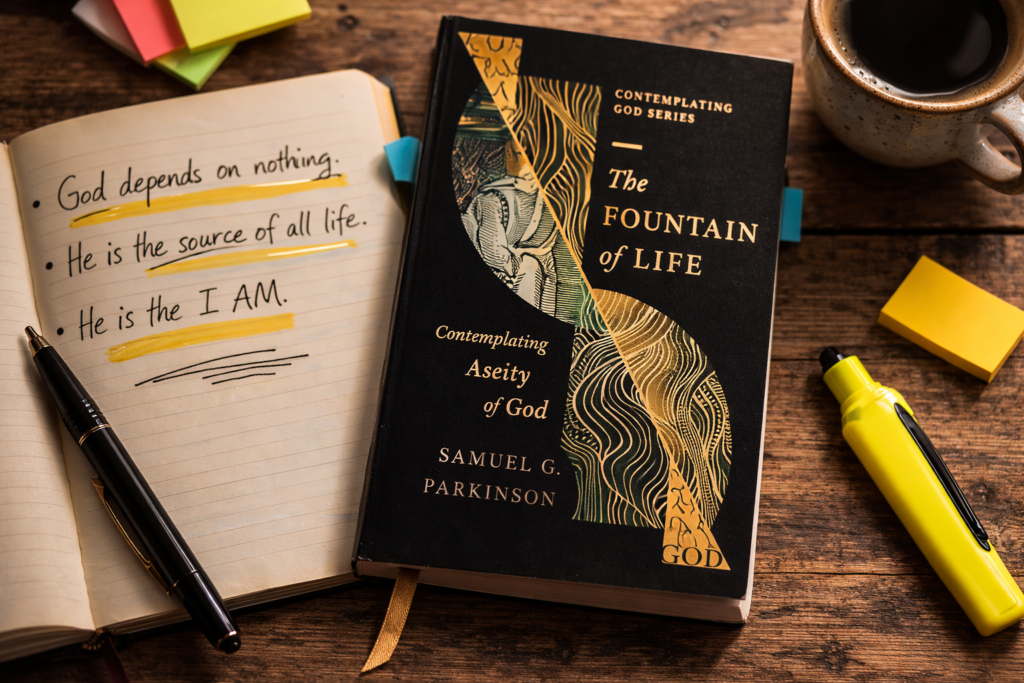
“What distinguishes God from all else is that he alone is absolutely independent” (Parkinson 2026, 18). This is seen in the first verse of Genesis. It is witnessed in the way God introduces himself to Moses as the “I AM.” It is present in John’s retelling of the Genesis story in his Gospel, as well as in Jesus’ teachings. This sense of self-sustaining, independent power “means that he is perfect—in need of nothing and no one to make him more alive, more powerful, more happy, more knowledgeable. Every other thing that exists gets all its life, power, happiness, and knowledge from him.” Such a reality is called the aseity of God, a largely underexplored topic in many Evangelical circles today (Parkinson 2026, 29).
To sing “Our God is a great big God” by Vineyard Worship and “Our God is an Awesome God” by Rich Mullins, take on bigger depths and more layers as we wrestle with God’s self-sustaining presence. The aseity of God is a truth about God that Parkinson simply defines as “God’s life is from himself (the word derives from Latin—the prefix a means ‘from,’ and se means ‘self’)” (Parkinson 2026, 5). The life from itself, self-sustaining, independent power of God is the subject of Samuel G. Parkinson’s theological overview in The Fountain of Life, published by Crossway (2026), and part of the Credo Series. It is a resource intended for pastors, lay leaders, and the church.
On the Rarity of the Doctrine
Though God’s being independent of his Creation might be referred to from time to time in the Fundamental circles in which I grew up and the evangelical ones that shaped me, I would say that the arguments for God’s Aseity, or the scriptural witness there of, was not and is not a doctrine that was or has been often discussed from the pulpit. While many sermon messages find their practical focus on God’s love, grace, or faithfulness, all of which are essential themes, there still remains in this post-everything culture, one matured in shallow waters, to grasp and develop the deeper theological foundations that undergird those realities of our walk with God. Doctrines like aseity actually quietly shape how we understand everything else about God. If God truly depends on nothing outside himself for life or being, then every act of creation, redemption, and care for his people flows not from necessity but from his free and gracious will. The aseity of God is not just his state of being, but it reveals his goodness and it reveals his good intentions.
Why This Book Caught My Attention
As a book reviewer, Crossway kindly provided this book for review, but it was the topic itself that drew my attention from the list of available titles. In my work and conversations with people who live at the intersections of life, especially through my work at Water Street Mission, I often hear descriptions of God that place him inside creation rather than above it. God is sometimes imagined as existing somewhere within the universe, growing with it, limited by it, or affected by forces beyond himself. There is a growing belief in people influenced by Tiktok and YouTube “teachers” that God is part of the universe and is learning and growing with it, with all of us. For this reason, sitting down to wrestle with one of those “Seminary topics,” with the classical Christian claim that God is utterly independent of creation felt timely. Parkinson’s treatment of aseity reminds readers of the God of the scriptures, the undercurrent of God’s sustaining power, in a practical way of the source from which all being flows.
An Implied Undercurrent
In my reading of this book, the first three chapters are perhaps the most important, followed by the last chapter. If you focus your reading on these chapters alone, you will walk away with a greater reverence for and sense of God, but also an appreciation for the character of a God like this that desires to come close to people like us. I believe these four chapters (1-3, 7) carry the biggest and most thorough arguments from Parkinson. This is a theological work, but it is not written in an academic tome. Parkinson outlines, in an introductory and overarching way, the witness of God’s aseity throughout the Old and New Testaments. It is not explicitly named, but it is an “implied undercurrent.”
As Parkinson states, “it doesn’t introduce divine aseity because it’s always assuming it” (Parkinson 2026, 9). That is one of the challenges that makes the aseity of God a big thing to take on in our studies or from the pulpit, because it is not explicit, but I do agree with Parkinson that it is always assuming it, and I would add that it is an implied undercurrent that continues to pull at the reader in the scriptures and this short read can help readers feel and see that undercurrent more for themselves as they read.
From the start of Genesis, we are introduced to a God who created out of nothing, sometimes referred to as ex nihilo, a narrative that witnesses to us that God is not part of creation. Creation is dependent on the Creator, but in no way is the Creator dependent on creation. Aseity reminds us, “We need him, but he does not need us at all” (Parkinson 2026, 9–10).
Parkinson does an excellent job unpacking God introducing himself as “I AM” to Moses. The statement, as it appears in the Old Testament, “means he is absolute, incomprehensible, unbounded Being. He never became, nor is he becoming—he simply is” (Parkinson 2026, 28). He could have expanded more on the past, present, and future aspects of God’s aseity, but from an introductory perspective, he unpacks the idea well.
The Psalms give us a similar view: “We learn that the cosmos has a Master. The earth does not simply happen to exist, and we do not simply happen to find ourselves here. Nothing that exists at all exists independently of the sovereign creative craftsmanship and sustaining grace of God,” or, said even more theologically, “God alone exists independently of anyone and anything. His existence is essential; ours is contingent and derivative. We are conditioned by him, but he is not conditioned by us” (Parkinson 2026, 12).
God is distinguished from and independent of all he creates. To be the Creator who creates, the one who is unbounded by creation, tells us he is also a source—a source in which “all life comes from him who is a boundless plentitude of life” (Parkinson 2026, 18). The aseity of God is more than just the negative—what he is not—but also what he is in positive ways. We worship a God who “needs nothing; it is rather the case that he needs nothing because he is the plentitude of life!” (Parkinson 2026, 19).
This is the God to whom we give ourselves, and the one with whom we share in the fountains of life he extends to us in eternity. “In him we live and move and have our being” (Acts 17:28). We creatures owe all that we are to God. But living and moving and having our being in him does not mean that he lives and moves and has his being in us (Parkinson 2026, 19).
The I AM
Though Parkinson takes on several statements in the scriptures, his work on the I AM statements with Moses was my favorite. Parkinson suggests that there were likely fragments of written accounts and oral stories about God and the character of God, but they surely did not yet have a canon of authoritative texts. So the liminal space in which they understood and interacted with God provided a foundation, as did the covenants, but nothing was as revelatory as when Moses learned the name of God as Yahweh. In Exodus 3:14–15, this self-revelatory statement names God as the one who is; Yahweh is “He Is” (Parkinson 2026, 23–24).
That identity shaped the stories both backward and forward as Moses recorded them: “It was ‘I AM’ who created the first man from the dust of the earth (Gen. 2:7); it was ‘I AM’ who flooded the earth, sparing Noah and his family (Gen. 6:5–8); it was ‘I AM’ who called Abraham to leave his country (Gen. 12:1), blessed his son Isaac (Gen. 26:12), and visited Isaac’s son Jacob in a dream (Gen. 28:10–22), and so on” (Parkinson 2026, 23–24).
The “I AM,” or “He Is,” “is the covenant name of the covenant-making, covenant-keeping God of Israel” (Parkinson 2026, 27). This statement, which speaks to his “absolute, incomprehensible, unbounded Being,” not only sets him apart but places him “over against every other kind of being since every other kind of being derives its being from another” (Parkinson 2026, 28).
That would have been deep encouragement to Moses in the predicament he was facing. As he prepared to go to Pharaoh, Moses heard not only a name but a trait of God—the essence of who God is: “He is the infinite source and giver of all life and being. Moses could not appeal categorically higher than to this Being for help in his task to deliver Israel from slavery” (Parkinson 2026, 32).
We Share The Promise of Forever
Parkinson ends with a promise and hope. We are reminded that “The eternal life of God is a foundation that flows from the headwaters of the Father and always and forever pours through the Son and in the Spirit, never beginning and never ending” (Parkinson 2026, 31). This aspect of who God is, which flows through the Son and in the Spirit, is also what we come to experience through the Son, by the Spirit (Parkinson 2026, 31).
I appreciate Parkinson’s remarks at the end: “Because we are finite and he is infinite, we can rejoice in the fact that our experience of eternal life will be marked by an increasing delight throughout this life and into the next, forever and ever” (Parkinson 2026, 69). That is the practical promise and hope of a God who is the I AM.
About Dr. Samuel G. Parkinson
Dr. Samuel G. Parkinson joined Credo in 2024 as the Director of Publishing. One of his first projects was working on the Credo Contemplating God series, which he co-edits with Matthew Barrett. A husband and father, Parkinson earned both his MDiv and PhD from Midwestern Baptist Theological Seminary. He is a strong writer and the author of several books.
About This Resource
This is an introductory, overarching theological work, but it is clearly written for pastors, students, and those in the pews. Readers do not need advanced theological training to follow Parkinson’s argument. The book is short and accessible, just under 100 pages, and is written by Parkinson. It is also part of the Credo series, edited by Matthew Barrett, Research Professor of Theology at Trinity Anglican Seminary, the founder of Credo. From what I can tell, the goal of the series is to introduce readers to key doctrines of the Christian faith in a way that is both theologically faithful and broadly accessible, and this volume fits that aim well.
This is what we walk away from, the greatest truth, a testimony of the goodness of God, “Because if God does not need us, then he has created and redeemed us out of his pure, undiluted, gratuitous, unconstrained, and noncompulsory love” (Parkinson 2026, 31).
One small drawback for me is the book’s framing. The work is sketched out in response to a question from Parkinson’s son about which is more eternal: God the Father or Jesus Christ. That question opens the book and returns again in the conclusion. Parkinson ultimately answers by writing, “Yes, God is more eternal. He is more eternal than the eternal life we are given in the same way that God is more than any other word we can apply to both God and ourselves. People can be ‘good,’ and God is ‘good’ (Parkinson 2026, 69). But his goodness transcends in every way the goodness of his creatures.” The point Parkinson presses is that even our participation in divine life remains creaturely. The hope of the gospel is not that we become divine, but that we share in the life of the One who is.
Pastoral Implications
Perhaps it is essential for us to wrestle with this more than ever. Aseity carries significant weight for the life of a follower of Jesus. In prayer—something I think about often as a doctoral student at Kairos University studying the Lord’s Prayer—we are reminded how immense the God we address truly is. When we pray “Our Father,” we are speaking to the independent source of all life who nevertheless invites us, his creation, into an intimate relationship. In seasons of suffering, this truth also steadies us. The God who sustains the earth, cares for the sparrow, and upon whom we cast our cares is not overwhelmed by our cares and concerns; he is so utterly distinct from creation that he is able to bear them. And in ministry, this doctrine cautions us to speak carefully about God. We must resist describing him as though he depends on our efforts or is sustained by our faithfulness. The God who calls us into his work remains the God who needs nothing from us, even as he graciously chooses to work through us.
Closing Thoughts
In the end, the greatest promise is that we will face the living God who extends his goodness to us. As Parkinson notes, divine life “is always that of a creature participating in the likeness of God’s aseity.” He concludes by reminding readers that “the only way for creatures to come to experience participation in the likeness of the divine is for their experience and delight of that infinite life to be everlastingly enlarged, forever and ever.”
That vision places the doctrine of God’s aseity where it belongs—not only as a theological category, but as a source of hope. The God who needs nothing has chosen to share his life with those who depend entirely on him.
Read my highlights on this book, or purchase it from Crossway!
Thanks for stopping by. I am Jeff McLain, and I write about the Quiet Way—a life shaped by the Lord’s Prayer, spiritual disciplines, and sustaining habits. Much of my work explores theology at the intersections of everyday life and the invitation of the scriptures to lead a quiet life. If this post encouraged you, consider sharing it with a friend, leaving a thought in the comments, or subscribing so you don’t miss future reflections. You can also find more of my writing at the Lead a Quiet Life blog on Patheos, and you can listen to the Discovering God Podcast, where we explore the scriptures and the life of faith together. I genuinely enjoy conversation. If something here resonated with you, feel free to reach out by email or connect with me on Facebook or Instagram.