
I used to work with a gentleman who was often overwhelmed by the tasks in front of him. He would shuffle his feet, walk around, and quietly repeat, “Better days are coming, better days are coming.” When things piled up, we would come alongside him and help carry the load together. He had another phrase he liked to say: “Teamwork makes the dream work.” This saying has shown up in many seasons of life, including when I try to convince my children to work together on a project.
Life is not easy. There are many days when we find ourselves shuffling our feet, just hoping for a better day tomorrow.
In his search for meaning, the writer of Ecclesiastes tried it all—money, success, education, and the accumulation of things. When none of it satisfied, he withdrew and began to discover something different: a kind of contentment found in living with God and receiving the moment at hand, with a gratitude for the gifts and graces God has extended to us.
Life works best when it is received with gratitude.
It is important to “give thanks in all circumstances,” to “do everything…giving thanks to God,” and to recognize that “this is the day the Lord has made” as we “rejoice and be glad in it” (1 Thessalonians 5:18; Colossians 3:17; Psalm 118:24, NIV).
Even more, this kind of gratitude—this enjoyment of life that learns to “eat and drink and find satisfaction” (Ecclesiastes 8:15, NIV)—is best lived with others.
For many, that is most deeply experienced within the context of a healthy partnership we call marriage.
Two Are Better Than One
In the middle of that search for meaning, the writer of Ecclesiastes says even in the weariness of life, there is something essential to be discovered—partnership.
He writes, “Two are better than one” (Ecclesiastes 4:9). Why? Because there is a better return for their labor. “If either of them falls down, one can help the other up” (4:10). Two can keep each other warm. Two can stand together in defense (4:11–12).
This passage is often read at weddings and applied to marriage, though hear me: that is not its primary intent. It speaks more broadly to the reality of life under the sun—how we toil, often for little gain, and how easily we fall into comparison and envy. It reminds us that much of what we chase is like chasing the wind. The author of this wise way realizes that teamwork makes the dreamwork when we are shuffling our feet and finding the tasks overwhelming.
And yet, even in a world marked by toil and oppression, one truth remains: it is not good for us to be alone.
That idea echoes back to Genesis. From the beginning, we were created for relationships, for shared work, for mutual support.
In the creation narrative, God declares into what is otherwise a good and ordered world, “It is not good for the man to be alone” (Genesis 2:18, NIV). It is there that God establishes a partnership, saying, “I will make a helper suitable for him.”
There is much to explore here—messianic echoes, theological contrasts—but at its core, this moment reveals something foundational: humanity is created for relationship. There is a human need for partnership. In our makeup, there is a complementary design, a bringing together of differences that forms a fuller picture of what it means to be human.
In a sense, even within a perfect creation, something was incomplete until this relationship was formed.
The word “helper” does not imply inferiority or servanthood alone. It carries the sense of strength, support, and partnership. It is a collaborative term—one who comes alongside, who strengthens, who upholds. Scripture even uses this language elsewhere to describe strength and aid.
Humanity needs this kind of mutual strengthening in relationships. A man and a woman together reflect a more complete expression of shared life and purpose. This is human relational design at its best.
From the beginning, the pattern is clear: we were not made to carry life alone.
Partnership Is A Repeated Yes
Partnerships also take work. Recently, on my Lead a Quiet Life Blog on Patheos, I mentioned that I once heard someone say that a successful marriage is one in which we fall in love with the same person over and over again. I don’t know who said it, but it has stayed with me.
This past week, Katie and I were on the Delmarva coast celebrating twenty years of marriage, and that line felt true. Our story has been one of learning to say yes to each other again and again. We were married on March 18, the day after St. Patrick’s Day, and in many ways, the last two decades have been a long series of small, steady yeses.
Relationships need time away and space to continually say “yes.”
Where It Started
We met in 2004 at the Lyndon Diner in Lancaster, Pennsylvania. I had just come back from a tour with some friends, and there was a gathering with local bands. I noticed Katie sitting at a table with a few guys I barely knew from a local Christian college, Lancaster Bible College. I didn’t know much about them, but I knew I wanted to meet her.
I joked with my friend Matt that I was going to talk to her. He joked back that if I didn’t, he would. So I walked over, introduced myself, and as they told me about their band, I invited them to play a show I had coming up. I already had enough bands and was fairly certain they wouldn’t fit, but I told them they could play the concert if they brought her.
I learned her name and that people called her “California Katie” because she had moved from the West Coast. Before long, we exchanged AOL Instant Messenger screen names. Within a few days, we were talking regularly. I was messaging her from the customer computer at Square One Coffee, and she was at Lancaster Bible College. Within a few days, we had a date.
And that was the beginning.
The band? They were terrible. People left the gig to go outside, and they went way over their allotted time. However, I won. I found my partner.
The Life We Have Lived
Since that first conversation, we’ve been learning what it means to fall in love again and again.
There have been tours, moves across the country, different jobs and seasons, buying a home, and raising three daughters. We’ve lived in Pennsylvania, California, and Virginia, and eventually found our way back to Pennsylvania, where we’ve built a life that is quieter and more rooted than the one we imagined early on.
Along the way, there have been real challenges. Katie developed epilepsy, which has shaped much of our daily life. She doesn’t drive, which means ordinary things require shared rhythms and support. A few years ago, I was diagnosed with type 1 diabetes, which has been its own ongoing learning curve.
There have been moments when things felt uncertain and heavy. But through it all, we’ve continued to say yes.
In many ways, our marriage has mirrored the kind of life I try to live—guided by a rule of life, shaped by values, and refined over time. We’ve grown up together, but we’ve also learned to find ourselves along the way. We are more certain now of who we are than we’ve ever been, and more willing to let go of what we’re not.
That early spark hasn’t lasted because we stayed the same. It has lasted because we stayed together.
On my Lead a Quiet Life Blog, I talk about the practices that sustained us.
Seven Bible Verses That Have Shaped My Marriage (and Still Are)
Marriage is not Christian only. However, Christian Marriage should set us apart. Our marriages should look different. They mirror God’s work and relationship with the people of God; they are full of eschatological symbolism, yet they are also a prophetic witness to the world and a place where God works. Christian Marriage, as evidenced in the scriptures, is different than the marriage of the world. These are some of the Scriptures I’ve tried to take to heart in marriage. You may find a few of these expected, and a few others less so. I will admit, there are some of these that I might have lived well. However, there are others that I am still learning.
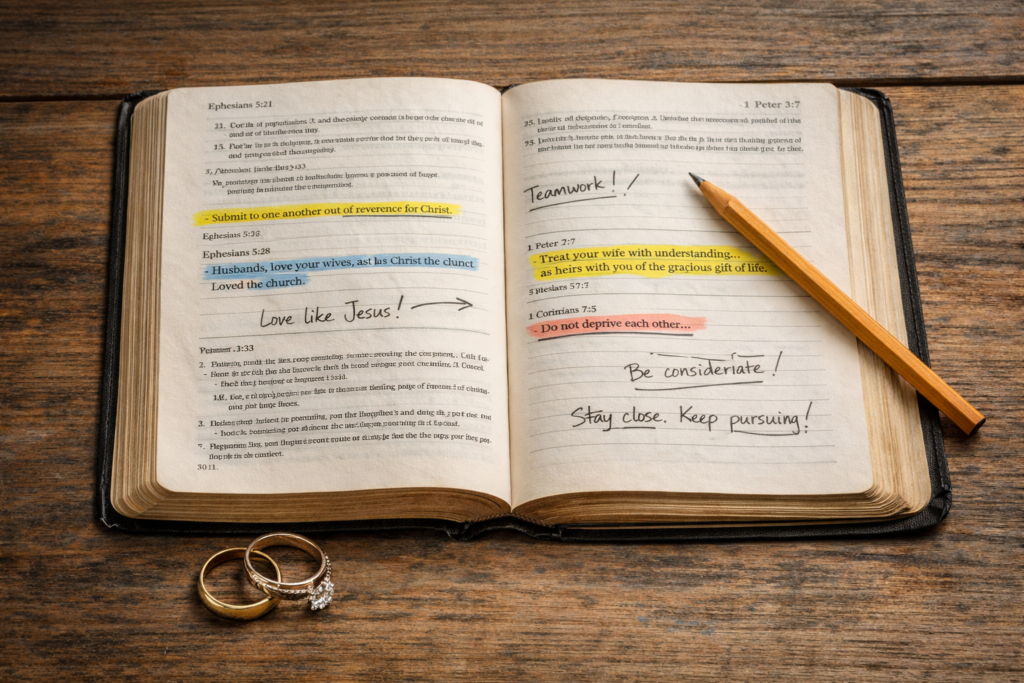
- Mutual submission (Ephesians 5:21). Paul writes about this, saying: “Submit to one another out of reverence for Christ.” Marriage is not about control. It is about partnership. I am called to listen, to yield, and to honor the other person, not just lead or decide.
- Love your spouse fully (Ephesians 5:28). Paul also expands on this, reminding me that I am called to love my spouse as I love myself. That means bringing my whole self into the relationship—emotionally, physically, and spiritually. Not halfway. Not when it’s convenient.
- Be careful what you say yes to (Deuteronomy 24:5). Moses records an important command for us. Scripture makes space for newly married life, protecting it from outside demands. I didn’t honor that well early on. I said yes to things that pulled me away. I learned the hard way that every yes carries weight, and some yeses cost more than they’re worth.
- See your marriage with gratitude (Proverbs 18:22). I love this line in Proverbs: “He who finds a wife finds what is good.” What I have is a gift. Gratitude is not automatic—it has to be practiced. I have to choose to see what is good rather than focus on what is missing.
- Speak beauty and honor (Song of Songs 4:1). Hear the words of the man in the Song of Songs, “Behold, you are beautiful…” There is something powerful about saying what is good out loud. Not assuming it is known. Not keeping it to myself. Speaking beauty matters.
- Treat your spouse with respect (1 Peter 3:7). Peter reminds me that I am called to be considerate, to treat my spouse with respect as a co-heir of grace. Not less. Not secondary. Equal in worth before God. How I treat my spouse even affects my spiritual life.
- Never stop pursuing one another (Proverbs 5:19; 1 Corinthians 7:4–5). Scripture is clear that intimacy matters; that is the heart of this Proverb. I am called to be satisfied, to delight, and not to neglect this part of the relationship. This is not separate from spiritual life—it is part of the covenant I am called to tend. Paul tells us something similar: never pull back from it.
Marriage is important. It was designed by God in the beginning. Even more, it mirrors the love God has for his people, and the way the marriage between Jesus and the bride will one day be consummated. How we steward our marriages then is a prophetic witness to the world around us.
I have also come to learn that in a loud, hurried world, marriage becomes one of the places where we learn a quieter, steadier way of living together.
Closing Thoughts on Marriage
There is no better way than seeing teamwork make the dream work. Better days may be coming, but the present ones are good too when you find a partnership that enjoys life with you—one that eats, drinks, and finds satisfaction together. Two are better than one. Steward what you have well.
Twenty years later, I still find her beautiful, and I am still saying yes. Repeatedly. We are still learning to make space for one another and to choose each other again and again. We continue to work at mutual submission, to love each other fully, and to be careful about what we allow to come between us in our schedules and commitments. There is a growing practice of gratitude and honor, and we are still learning what it means to treat one another with respect and to pursue each other well.
The Scriptures continue to guide us. They teach, correct, and shape us, becoming a lamp to our feet—even in the practical, everyday areas of life (Psalm 119:105). Marriage is one of the places where faith is not abstract but lived.
In your own marriage, find life in the Scriptures. Let them form you. And I’d be curious—what have I not mentioned that you love about Christian marriage? What passages have shaped the way you love, stay, and keep saying yes?
Thanks for stopping by. I am Jeff McLain, and I write about the Quiet Way—a life shaped by the Lord’s Prayer, spiritual disciplines, and sustaining habits. Much of my work explores theology at the intersections of everyday life and the invitation of the scriptures to lead a quiet life. If this post encouraged you, consider sharing it with a friend, leaving a thought in the comments, or subscribing so you don’t miss future reflections. You can also find more of my writing at the Lead a Quiet Life blog on Patheos, and you can listen to the Discovering God Podcast, where we explore the scriptures and the life of faith together. I genuinely enjoy conversation. If something here resonated with you, feel free to reach out by email or connect with me on Facebook or Instagram.
