
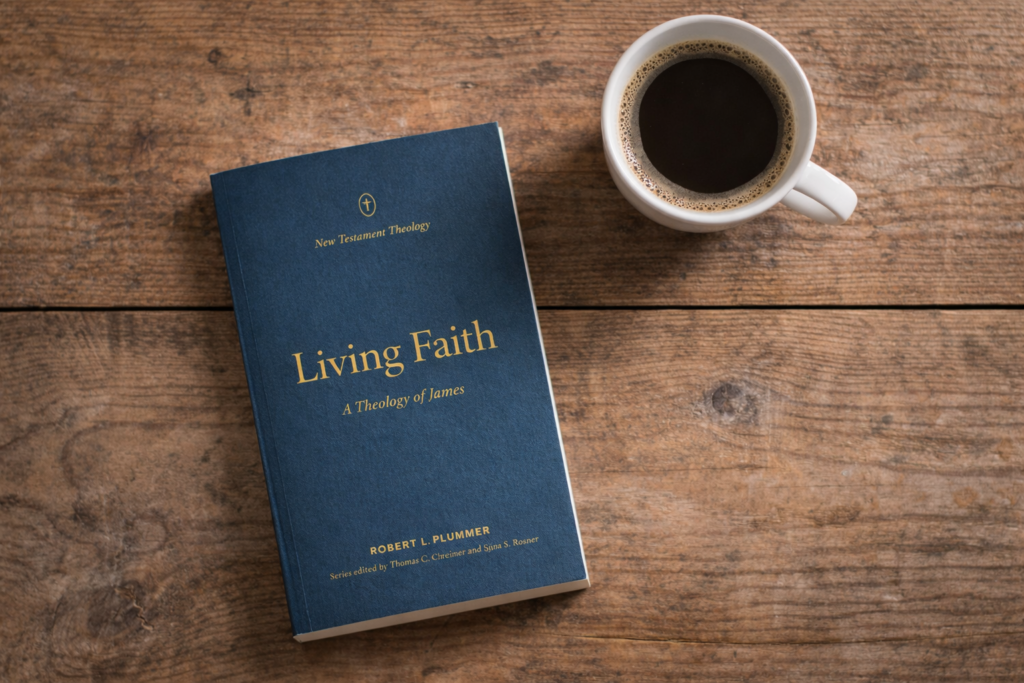
“In some ways, the letter of James is like a pastoral blog—with a series of reflections about practical Christian living,” observes Dr. Robert L. Plummer (Plummer 2025, 3). This practicality, which makes James a favorite epistle for many, is also central to Living Faith: A Theology of James, released in 2025 as part of the New Testament Theology Series from Crossway. In the preface, editors Thomas R. Schreiner and Brian S. Rosner share similar thoughts, remarking, “The letter of James is one of the most practical in the New Testament, and believers often study it to learn what it means in everyday life to be a disciple of Jesus Christ” (Plummer 2025, X). This small but intense booklet on James offers a unique take on a New Testament epistle that I find myself meditating on and preaching from quite regularly.
New Testament Theology Series
This intensive and exhaustive resource on James is part of the New Testament Theology series and is neither a biblical commentary, a dictionary, nor a volume focused on a specific theological theme or systematic theology. Rather, the authors in this series seek to unpack the theology of each New Testament book in its own context, “from the perspective of biblical theology,” paying attention to the specific “historical and literary dimensions of the text,” while also “presenting the teaching of particular New Testament books about God and his relations to the world on their own terms, maintaining sight of the Bible’s overarching narrative and Christocentric focus” (2025, ix).
There are twenty volumes in this series that aim to provide, as the editors call it, a comprehensive, scholarly, and accessible treatment of the theological themes of Scripture from a traditional evangelical perspective, useful to students, preachers, and laypersons seeking to learn more.
Specifically, with the book of James, we encounter one of the most practical yet complex New Testament epistles. Many have raised concerns about James, such as the well-known objections of Martin Luther, because, as the editors point out, “the cross and resurrection of Jesus are not even mentioned” (2025, x). However, in this book, we find a fresh look at an epistle that offers not only a richer theology of faith and works than we often give it credit for, but also reminds us “of the vitality of the new life to which we are called,” challenging us to live lives of faith, hope, and love with a deeper understanding of James (2025, x).
A Unique Look at the Living Faith of James
While I often rely on commentaries, this volume offered a different kind of engagement with James—one that I came to appreciate as I worked through it. In the introduction, Plummer unpacks James as the author, arguing that he is James, the son of Mary and half-brother of Jesus. Plummer also points to the more original form of James’s name, Jacob. He then explores the date of authorship. We know James was martyred by AD 62, so the letter must have been written sometime before then.
Plummer does a good job describing his martyrdom as an act of “Jewish religious authorities who were angry at his Christian influence on Jews in Jerusalem,” though the brevity here, for me, takes away from some of the scriptural and historical witness to James’s life and his convictions, particularly his concern for the poor—something that seems largely overlooked.
Plummer then examines James’s organization in the introduction, comparing it to a pastor’s blog with a series of thematic reflections. The introduction is followed by six chapters and a conclusion that analyzes James through its thematic emphases and theological framework rather than offering a traditional expository commentary.
A Few Wins and Losses from Living Faith
Plummer certainly presents James as a letter with “plenty of…instruction that is both clear and immediately applicable” (2025, 5). To lose sight of this would be to lose sight of James for me. However, Plummer does not always make those applications clear for our post-everything era. Though James seems clear, I think we need to bridge the connections for readers in a post-everything, including post-trust, age. I deeply appreciated his unpacking of James’s use of the term doulos, but his strongest and most unique contribution is his ability to highlight Christological connections—both those that are explicit and those that are “debated” but difficult to ignore. Another strength is the way Plummer shows how “much of the letter parallels Jesus’ teaching in the Sermon on the Mount,” exploring that pattern in a helpful way (2025, 11).
He briefly engages Luther’s concerns about James—though, in my view, both Luther and James often misunderstood James—but does not explore patristic perspectives in much depth, which I always appreciate seeing more of. A fuller treatment of the historical, ethical, and moral dimensions would have strengthened the book for me, but maybe not everyone. That said, Plummer handles some of James’s more difficult passages well, including themes such as sickness and sin, faith and works, and other tensions that often pose interpretive challenges.
Plummer also does a strong job of highlighting James’s pastoral posture, something I have seen many overlook when studying and preaching this book. As Plummer notes, “even as James lays out such polarizing theological appeals, he reminds his readers that he is their spiritual sibling, and by calling them ‘brothers,’ he assures them that he is appealing to them as a fellow community member” (2025, 23). This tone is a recurring reality throughout the Jacobean epistle as James addresses the church as family (adelphoi). I did not have time to fully explore Plummer’s claim that James contains more imperatives per total word count than any other New Testament book, but it seems true and plausible, given the consistent call to active, “living faith” throughout the epistle. Plummer also provides a helpful treatment of the tension between trials and temptations, reminding us that struggle is unavoidable.
For me, I guess I would say that one of Plummer’s weaker points, beyond the limited practical application, is his treatment of oaths. He argues that “the apostles and even Jesus took oaths or submitted to being put under oath,” drawing on passages such as Matthew 26:63–64, 2 Corinthians 11:31, Galatians 1:20, and Philippians 1:8. For a literal interpreter, I think he fails to follow his own rules here and makes some word-smithing errors. To support this, he interprets Jesus’s teaching on oaths (Matthew 5:33–37; 23:16–22) not as a prohibition, but as a warning against casual or careless use. While he rightly notes that “humans would never need to swear oaths if their speech were consistently truthful and forthright,” I am not convinced by his conclusion. I think he underestimates the plain force of Jesus’s teaching, which James seems to reinforce. Though Plummer pushes back against traditions such as the Mennonites, who take these prohibitions literally, I find myself aligned with that more straightforward reading and remain unconvinced by his argument here. He certainly gives space for one to understand this based on their conscience, but James cannot be clearer, oaths are not needed for the Christian, because our “yes” and “no” should be lived out in a way that states who we are “oathed” to.
Let me say this yet, his chapter on prayer stands out as another strength. As a doctoral student on the Lord’s Prayer at Kairos University, I found Plummer’s emphasis on praying for wisdom is particularly timely and needed in this messed-up, crazy, and confused world. This chapter on prayer offers a fitting reminder of the kind of faith James calls us to live.
About Robert L. Plummer
Dr. Robert L. Plummer serves as Professor of Biblical Studies at the Southern Baptist Theological Seminary. He is also known for his resources on teaching biblical Greek, including his screencast DailyDoseofGreek.com. Plummer has authored, coauthored, and edited many books over the years.
While I could not identify a specific theological stream with which Plummer most closely aligns, I would describe him as broadly Reformed-leaning, as evidenced by some of his writings, his treatment of James, and other resources. However, his theological system is not central to this book. Instead, he traces key themes: Jesus Christ, the Lord of Glory; living faith that has works; trials and temptations; poverty and riches; speech and anger; and prayer. He seeks to trace these teachings for the early churches in Jerusalem and, ultimately, for us, connecting them to Jesus and the broader witness of Scripture.
Closing Thoughts
This book is a helpful resource for exploring the key topics and ideas presented in James. It is far from exhaustive, in my opinion, but it offers some unique angles you will not find in a commentary—such as how Plummer connects the teachings in James with corresponding ideas from Jesus’ teachings in the Gospels.
It is a small volume, slightly larger than a 5×7 photo, and just over 100 pages, with what appears to be 11- or 12-point font. Plummer’s approach is not exhaustive and does miss some of the historical depth that commentaries provide—material I think is important to explore. However, there are few resources like this that help contemporary readers identify and understand the Christological and soteriological themes, or “underpinnings,” as Plummer describes them. Plummer’s hope is that, like James’s earliest readers, we would come to understand the wisdom found in this letter.
This is a helpful resource for anyone studying or teaching James—whether you’re a preacher, teacher, layperson, or someone suddenly leading a small group. Priced just under $20 (and often available for less when bought directly through Crossway), it’s an accessible addition to your shelf. While I will continue to rely on commentaries, this volume offers a needed bridge between James and Jesus, a connection some overlook or struggle to develop. I do wish it explored more of the practical, ethical, and quietly resistant way of life James calls us to, but it remains a valuable theological resource.
Thanks for stopping by. I am Jeff McLain, and I write about the Quiet Way—a life shaped by the Lord’s Prayer, spiritual disciplines, and sustaining habits. Much of my work explores theology at the intersections of everyday life and the invitation of the scriptures to lead a quiet life. If this post encouraged you, consider sharing it with a friend, leaving a thought in the comments, or subscribing so you don’t miss future reflections. You can also find more of my writing at the Lead a Quiet Life blog on Patheos, and you can listen to the Discovering God Podcast, where we explore the scriptures and the life of faith together. I genuinely enjoy conversation. If something here resonated with you, feel free to reach out by email or connect with me on Facebook or Instagram.